Lymphatic drainage massage is one of the gentlest treatments you can book, and one of the most misunderstood. It isn't a deep massage, it isn't a "detox", and it isn't meant to hurt. This guide explains what it really is, how it works with your body, and why so many women make it part of their self-care.
First, what is the lymphatic system?
Your blood circulation has a pump, the heart. Your lymphatic system doesn't. It's a quieter network of fine vessels, lymph nodes and organs that collects the fluid that naturally seeps out of your blood capillaries into the spaces between your cells, and returns it to your bloodstream.
Along the way that fluid, now called lymph, passes through lymph nodes. You have roughly 600 of them, clustered in places like your neck, armpits, abdomen and groin. They filter the lymph and are home to many of your immune cells. So the lymphatic system has two big jobs: keeping your body's fluid balance steady, and playing a central part in your immune system.
Because there's no central pump, lymph relies on other things to keep it moving:
- Muscle movement: when muscles contract they squeeze nearby lymph vessels, pushing fluid along.
- Breathing: deep breaths change the pressure in your chest and help draw lymph towards the centre of the body.
- The vessels themselves: larger lymph vessels contract rhythmically in small segments, with one-way valves stopping fluid flowing backwards.
This is why long days sitting at a desk, long drives or long flights can leave your ankles and legs feeling heavy: less movement means less help for lymph flow.
So what is lymphatic drainage massage?
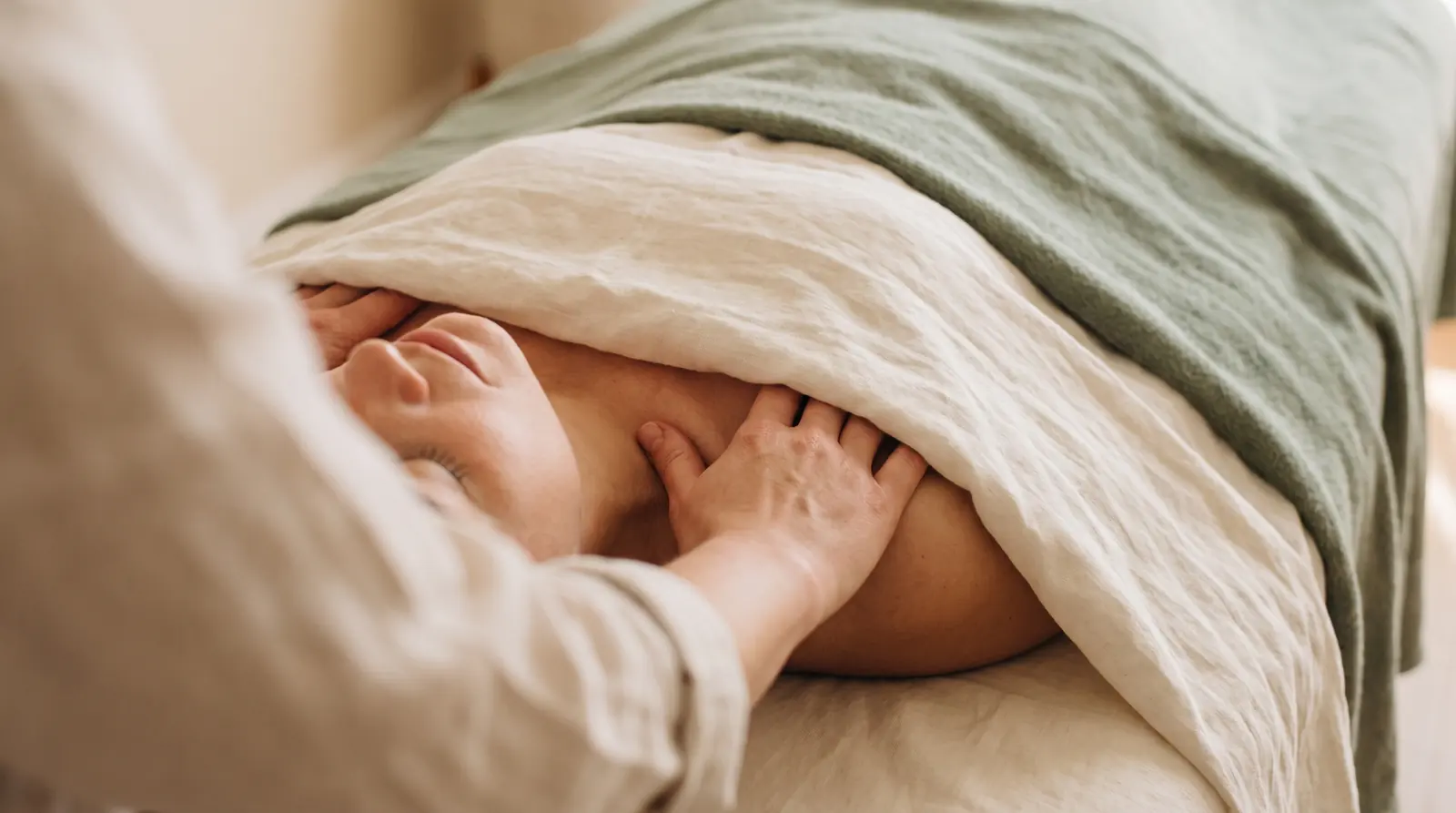
Lymphatic drainage massage uses very light, slow, rhythmic movements that gently stretch the skin in the direction lymph naturally flows, generally towards the lymph nodes and back towards the centre of the body.
The lightness is the whole point. Much of the lymphatic network begins just beneath the skin, in tiny, delicate vessels. These are attached to the surrounding tissue by fine filaments, and when the skin is gently stretched, those filaments tug the vessel walls open so fluid can move in. Press too hard and you flatten the very vessels you're trying to encourage. That's why a good lymphatic drainage massage can feel almost surprisingly soft.
Where the technique came from
Manual lymphatic drainage was developed in the 1930s by a Danish couple, Dr Emil Vodder and Estrid Vodder, while they were working in Cannes on the French Riviera. They noticed that many of their patients with frequent colds and sinus problems had swollen lymph nodes in the neck, and began experimenting with gentle, rhythmic movements over those areas at a time when touching the lymph nodes was considered off limits. They presented their method in Paris in 1936.
Since then, the approach has gone in two directions. In healthcare, specially trained lymphoedema therapists use manual lymphatic drainage as one part of managing medically diagnosed swelling, usually alongside compression, skin care and exercise. In the wellbeing world, the same gentle principles are used as a relaxing full-body treatment for people who simply want to feel lighter, calmer and more comfortable in their bodies. My treatments at Willow & Flow are the second kind: holistic, relaxing and supportive, not medical.
What does a lymphatic drainage massage feel like?
Most women describe it as deeply calming. The strokes are slow and repetitive, almost like a rhythm, and the pressure is light enough that many clients drift off. Common words afterwards are "lighter", "less puffy", "floaty" and "so relaxed".
At Willow & Flow, a full-body treatment takes 60 to 90 minutes and includes gentle movements across the face, arms, stomach, legs and back. You can read exactly what happens at your first appointment here.
Why a holistic approach?
A holistic treatment looks at how you feel as a whole person, not just one part of the body. Lymphatic drainage massage fits naturally here, because the experience works on several levels at once:
- Body: gentle, directional strokes designed to work with your natural fluid movement.
- Nervous system: slow, rhythmic touch is one of the most reliable ways to help the body shift out of "busy" mode and into rest.
- Mind: an hour or more where nothing is asked of you. For a lot of women that's the rarest part.
That doesn't mean it replaces anything medical. If you have a health condition, the right place to start is your GP, and there are some situations where this treatment isn't suitable at all. I've written a clear guide to who shouldn't have lymphatic drainage massage.
Common myths, cleared up
"It flushes out toxins." Your liver and kidneys handle waste removal, and they don't need a massage to do it. Lymphatic drainage massage is about supporting comfortable fluid movement and deep relaxation, not "detoxing".
"It should hurt to work." The opposite. Firm pressure is counterproductive for the superficial lymph vessels.
"It's a weight-loss treatment." It isn't. Some women notice they feel less puffy, but that isn't fat loss and shouldn't be sold as such.
Is it for you?
If you often feel heavy, puffy or tense, if you spend long hours sitting or on your feet, or if you just want a truly restful treatment that feels different from a normal massage, it's well worth trying. I offer women-only lymphatic drainage massage at North Wales Nail & Beauty in Llandudno, with clients travelling in from Conwy, Colwyn Bay, Rhos-on-Sea and further along the coast.
Lymphatic drainage massage in Llandudno
60–90 minutes · £65 · women only · North Wales Nail & Beauty, 24 Brookes Street, Llandudno LL30 2TT
Request an AppointmentFrequently asked questions
Is lymphatic drainage massage the same as a normal massage?
Who invented lymphatic drainage massage?
Does lymphatic drainage massage detox the body?
Further reading & sources
This article is general wellbeing information, not medical advice. Lymphatic drainage massage at Willow & Flow is a relaxation and wellbeing treatment, not a medical treatment. If you have a health condition or symptoms, please speak to your GP.